

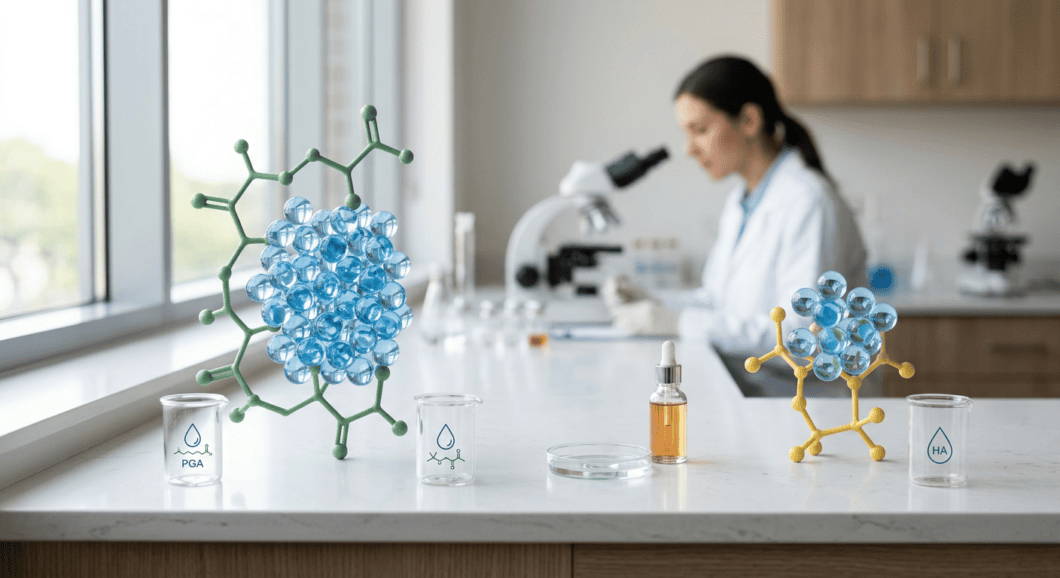
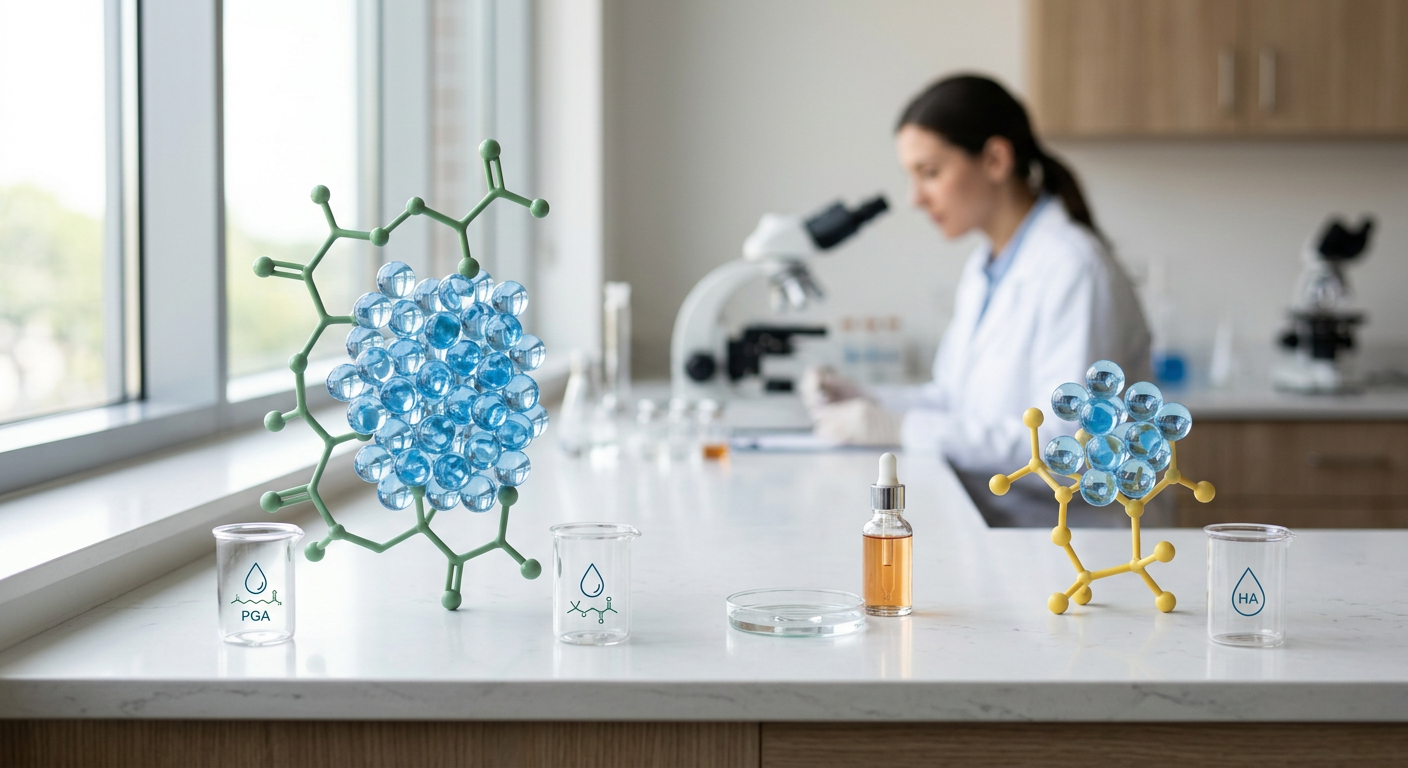
Polyglutamic acid holds up to four times more moisture than hyaluronic acid. That number alone explains why formulators, dermatologists, and skincare shoppers keep circling back to it. The fermented, biodegradable humectant has moved from a niche ingredient to a headline act in serums launching for 2026. Hyaluronic acid has run the hydration conversation for the better part of a decade, but that grip is loosening. Polyglutamic acid, usually shortened to PGA, is the ingredient brands and buyers are watching now.
This isn’t a marketing invention. Market data, formulation trends, and clinical interest all point the same way. What follows is what PGA is, why demand is climbing, and how to decide whether it earns a place in your routine.
What Polyglutamic Acid Actually Is

Polyglutamic acid is a peptide that forms when multiple molecules of glutamic acid link together through fermentation. The result is a natural, biodegradable polymer that works as a strong humectant, drawing and holding water at the skin’s surface. According to Biossance, PGA can also penetrate the top layers of skin to support collagen production.
Two forms are worth knowing. Alpha-PGA turns up in some cosmetic contexts. Gamma-PGA is the fermentation-derived version you’ll find in most skincare and industrial applications, and it’s produced through bacterial fermentation. That sourcing appeals to brands that want a sustainability story without stretching the truth.
Why Fermentation Matters
Fermentation-derived ingredients carry both a marketing and a functional advantage. They’re biodegradable, renewable, and increasingly preferred as regulators tighten the rules on synthetic polymers. That positions PGA as a bio-based alternative in a market steadily walking away from petroleum-derived actives.
Why Demand Is Surging Right Now

The trend shows up in the numbers. The global high-purity polyglutamic acid market sat at roughly USD 164.8 million in 2025 and is projected to reach USD 388.2 million by 2036, a compound annual growth rate of 8.1%, according to Fact.MR.
Cosmetic-grade PGA drives most of that. It’s expected to hold about 41.80% of the market by 2026, which reflects its widening role in skincare formulations and tissue engineering. When one grade commands more than 40% of a market, that signals sustained commercial confidence rather than a passing fad.
Beauty isn’t the only pressure on demand. Regulators in the European Union and North America are restricting polyacrylamide-based synthetic polymers used in water treatment and agriculture, which opens a large market for gamma-PGA as a bio-based substitute, per Dataintelo. Cross-industry demand of this kind tends to stabilize supply and pull long-term costs down.
Polyglutamic Acid vs. Hyaluronic Acid
The question buyers ask most is how PGA stacks up against hyaluronic acid (HA), the long-standing hydration benchmark. Both are humectant polymers that maintain the skin’s water content, which affects elasticity, barrier function, and overall skin health, as Prequel explains.
The difference comes down to moisture retention and film formation. PGA holds considerably more water and forms a breathable film on the skin’s surface, which locks hydration in rather than letting it evaporate.
| Feature | Polyglutamic Acid (PGA) | Hyaluronic Acid (HA) |
|---|---|---|
| Moisture retention | Holds up to 4x more moisture | Industry hydration standard |
| Surface action | Forms a breathable film | Draws water into skin |
| Primary benefit | Locks in and seals hydration | Plumps and hydrates layers |
| Source | Fermentation-derived polymer | Fermentation or synthetic |
| Skin suitability | Suitable for sensitive skin | Widely tolerated |
Should You Choose One or Both?
Expert consensus favors combination over competition. As the Los Angeles Times reports, the current trend is pairing hyaluronic acid with polyglutamic acid. HA pulls moisture into the deeper layers, PGA seals it at the surface, and the two reinforce each other instead of overlapping.
The Formulation Trends Driving Adoption

PGA fits the direction skincare is already moving. Industry analysts at UL Prospector name polyglutamic acid the “Hydration 2.0” ingredient in their 2026 serum trends, citing its capacity to hold four times more moisture than HA and form a breathable film.
The broader serum market is shifting from single hero actives toward bio-intelligent formulas that work with the skin’s own systems. PGA supports that shift because it pairs cleanly with barrier protectors like ectoin and retinol alternatives such as bakuchiol.
Where PGA Shows Up
- Hydrating serums and essences
- Sheet and overnight masks
- Moisturizers and barrier creams
- Primers and hydrating makeup hybrids
That versatility carries weight. An ingredient that layers well and suits sensitive skin gives formulators room to build entire product lines around it.
Who Should Use Polyglutamic Acid

PGA is unusually forgiving. Skincare experts describe it as an ingredient that “plays well with anyone, anytime, anywhere,” and Glow Recipe notes there are no meaningful drawbacks, even for the most sensitive skin.
If your skin feels dry, tight, or dehydrated by midday, PGA’s film-forming action can hold moisture where HA alone falls short. It’s also a smart pick if you already use retinoids or exfoliating acids, since the extra hydration helps buffer potential irritation.
How to Add It to Your Routine
Apply PGA to damp skin after cleansing and before heavier creams, so the film seals in the moisture beneath it. To get the most out of it, layer it over a hyaluronic acid serum, then follow with a moisturizer. That sequence puts each ingredient where it does its best work.
What the Growth Means for Buyers and Brands

For consumers, rising demand and cross-industry adoption point toward wider availability and more competitive pricing over the next decade. As fermentation yields and processing efficiencies improve, PGA should start showing up in mid-range products, not just premium serums.
For brands and formulators, the data makes a clear case. A market growing 8.1% a year, combined with regulatory tailwinds favoring bio-based polymers, gives PGA the kind of durability that trend-driven ingredients usually lack. Building PGA-forward formulations lines up with both consumer demand and where regulation is headed.
Conclusion
Polyglutamic acid is trending for reasons that survive scrutiny. It retains up to four times more moisture than hyaluronic acid, forms a protective breathable film, suits sensitive skin, and sits at the center of 2026’s biggest formulation trends. Market projections back the momentum, with the high-purity PGA market on track to more than double to USD 388.2 million by 2036.
The practical takeaway: you don’t have to choose between PGA and hyaluronic acid. Use them together to hydrate deeply and seal that moisture in. If your current routine leans on hyaluronic acid alone, adding a polyglutamic acid serum is the most effective upgrade you can make this year. Start with a single PGA product, apply it to damp skin, and judge the results for yourself.
Frequently Asked Questions
Q: Is polyglutamic acid better than hyaluronic acid?
Polyglutamic acid holds up to four times more moisture and forms a breathable film that seals hydration at the surface. Rather than replacing hyaluronic acid, it works best alongside it, since HA hydrates deeper layers while PGA locks moisture in.
Q: Can polyglutamic acid be used on sensitive skin?
Yes. Skincare experts describe PGA as suitable for even the most sensitive skin, with no meaningful drawbacks reported. It’s a gentle humectant that can also help buffer irritation from stronger actives.
Q: How do you apply polyglutamic acid?
Apply it to damp skin after cleansing and before heavier moisturizers. For best results, layer it over a hyaluronic acid serum so it seals in the hydration beneath.
Q: What is polyglutamic acid made from?
It’s a fermented, biodegradable polymer that forms when multiple molecules of glutamic acid link together. Most cosmetic PGA is gamma-PGA produced through bacterial fermentation.
Q: Is polyglutamic acid worth the hype?
The data says yes. The market is projected to grow at an 8.1% CAGR through 2036, and formulators rank it among the top hydration ingredients for 2026, on the strength of proven moisture retention and skin compatibility.
Q: Can I use polyglutamic acid with retinol?
Yes. PGA pairs well with retinol and retinol alternatives, and its added hydration can help reduce the dryness or irritation those actives sometimes cause.