



Most people own far more products than they use. The bathroom shelf has eight bottles, three of them nearly empty. The desk has four apps open that all track the same tasks. Things accumulate. Effectiveness doesn’t.
The fix isn’t finding something better to buy. It’s getting more out of what you already have.
Why More Products Usually Mean Worse Results
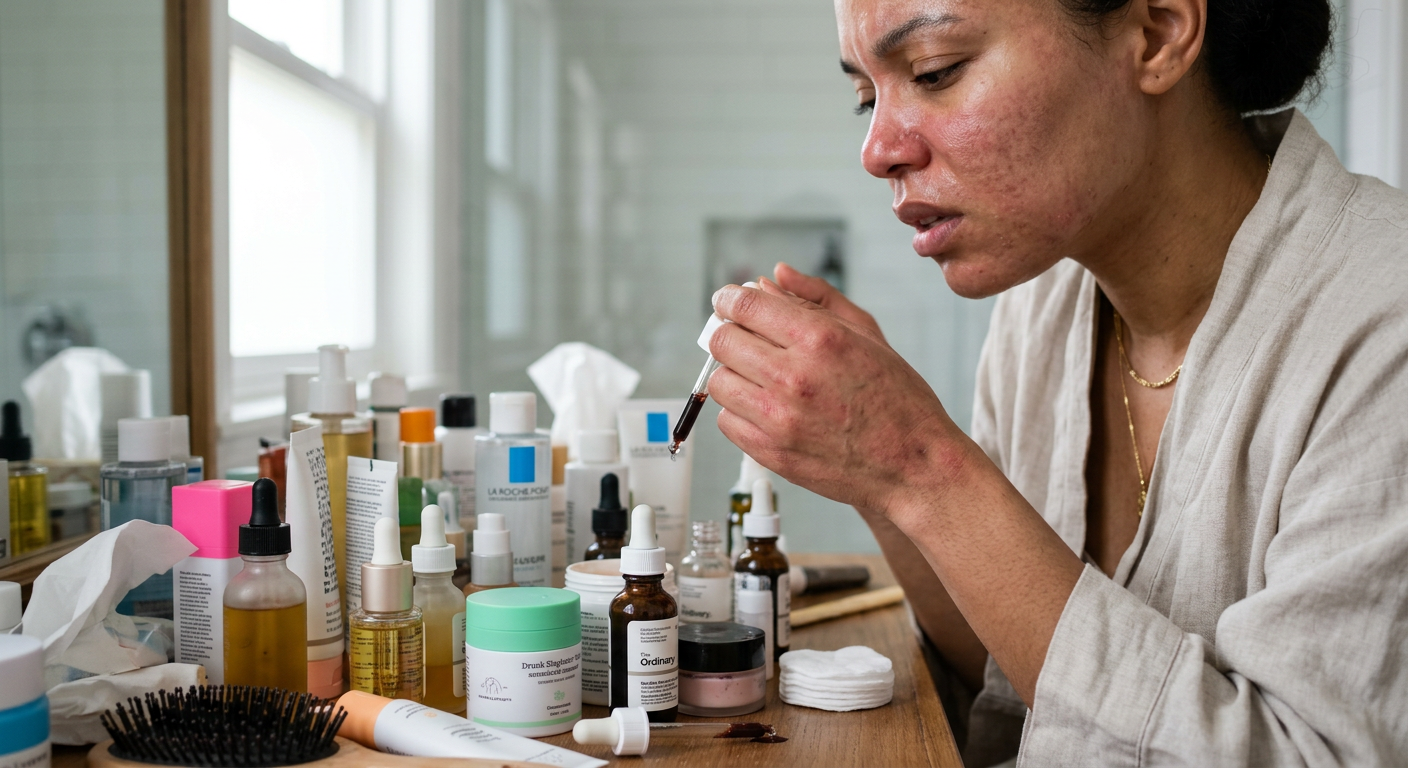
Adding more rarely improves outcomes — and often makes them worse. Layer too many active ingredients on your skin and they start working against each other, reducing efficacy or causing irritation. Add another productivity app to an already crowded system and you spend your time managing the system instead of doing the work.
According to Brilliance Beauty, a minimalist approach isn’t about doing less — it’s about doing what actually matters and cutting the rest. That’s not deprivation. It’s precision.
The same logic holds outside skincare. The Deskera productivity guide recommends keeping task lists short and measuring results rather than effort — which translates directly to any routine that’s grown too complicated. Fewer items, clearer outcomes.
How to Audit What You Actually Use

Before you can simplify, you need an honest count. Pull everything out of the drawer, shelf, or cabinet and lay it flat. The visual confrontation alone tends to settle things quickly.
The 30-Day Use Test
One question per item: did you use this in the last 30 days? If not, it goes into one of three piles — discard, donate, or deliberate trial. A deliberate trial means you give it a specific two-week window to prove its value, then decide.
The Overlap Check
Look for products doing the same job. Three moisturizers. Two project management tools running simultaneously. Four note-taking apps. Redundancy feels like a safety net but functions as clutter. Find the best performer in each category and cut the rest.
This is the 80/20 principle applied in practice: a small fraction of your products or habits generate most of your results. The Reddit productivity community puts it plainly — prioritize the 20% of tasks that yield outsized results and put real effort there, not spread evenly across everything.
Choosing Products That Pull Double Duty

After the audit, the next step is strategic replacement. The target is multi-functional products that earn their place by covering more than one job.
What Makes a Product “Work Harder”
A product works harder when it addresses multiple needs without adding steps. In skincare, a tinted SPF moisturizer replaces three separate products. In a work context, a single project management tool that handles tasks, timelines, and communication replaces three separate apps.
One caveat worth taking seriously: a multi-function product has to do its primary job well. A mediocre SPF that also moisturizes poorly isn’t a win. Quality first, consolidation second.
Building a Routine Around Consistency, Not Variety

Consistency compounds. A simple routine you follow every day outperforms a complex one you follow three times a week — and that’s before accounting for the mental overhead of remembering the complex one.
Danielle Gervino’s productivity framework emphasizes sticking to a schedule and declining things that don’t serve your priorities. The same discipline applies here. A five-step skincare routine or a three-tool productivity stack, used without exception, will beat a twelve-step system that gets abandoned by Thursday.
The Role of Habit Anchoring
Attach your streamlined routine to something you already do. If you make coffee every morning without thinking about it, that’s the moment to run a two-minute skincare routine or check a single prioritized task list. Behavioral scientists call this habit stacking — a new behavior attached to an existing one requires less willpower to maintain.
Fewer products make this easier. There’s nothing to remember except the routine itself.
Knowing When a Product Has Earned Its Place

Keeping fewer products doesn’t mean keeping them indefinitely. Each item should earn continued inclusion through demonstrated results — which means evaluating outcomes rather than assuming value.
Run a 60-day review. What’s changed since you started using or kept a product? Skin clearer? Focus sharper? Sleep better? If you can’t point to a noticeable improvement, the product is occupying space without delivering value.
This is the same standard Venture X applies to healthy work habits: build practices that create clarity and sustainable results, then check whether they’re actually working. Routines are systems. Systems need maintenance.
The Financial Case for Doing Less

The economics are simple and usually underestimated. Spending $40 a month on products you use inconsistently costs more over a year than spending $60 on two products you use every day — and delivers less.
Beyond direct cost, there’s the hidden expense of decision fatigue. Every product you own is a small decision you make each morning. Research consistently shows that decision fatigue degrades the quality of subsequent choices throughout the day. Fewer products, fewer decisions — and that savings compounds.
Brilliance Beauty puts it directly: simplifying saves time, money, and mental energy. All three are finite. Treating them that way changes how you evaluate every product you consider keeping.
Conclusion
Making fewer products work harder is a question of intentionality, not restriction. Audit what you have, replace redundancies with multi-function options, build consistency through habit anchoring, and review results on a fixed cycle. The routine that comes out of that process is easier to maintain, more effective in practice, and cheaper over time.
Start with one shelf or one category this week. Pull everything out, apply the 30-day use test, and cut the overlap. One honest audit and the discipline to act on it is enough.
Frequently Asked Questions
Q: How many products should a basic skincare routine include?
Three to four: a cleanser, a moisturizer, and an SPF for daytime. Serums or exfoliants can come in later, but only if they address a specific, identified concern — not as a default addition.
Q: How do I know if two products are redundant in my routine?
If they serve the same primary function — hydration, cleansing, exfoliation — you probably only need the one that performs better. Check ingredient lists for significant overlap, which is usually a reliable sign.
Q: Does simplifying a routine mean sacrificing results?
Not if you choose products that match your specific needs. Most dermatologists and estheticians agree that consistent use of a few well-chosen products outperforms an inconsistent complex routine.
Q: How long should I trial a new product before deciding to keep it?
Four to six weeks for skincare, since skin and habit cycles both take time to reflect change. For productivity tools, two weeks of consistent daily use is usually enough to assess whether something fits.
Q: Can this approach work for productivity tools and apps, not just beauty products?
Yes. The same audit and consolidation principles apply to digital tools. Identify what you actually use daily, cut the overlap, and choose platforms that handle multiple functions without requiring you to switch between systems constantly.
Q: What’s the biggest mistake people make when trying to simplify their routine?
Cutting products without first identifying which ones are actually driving results. Track what you use and what changes you notice, then eliminate from the bottom of the value list — not arbitrarily from the top.