

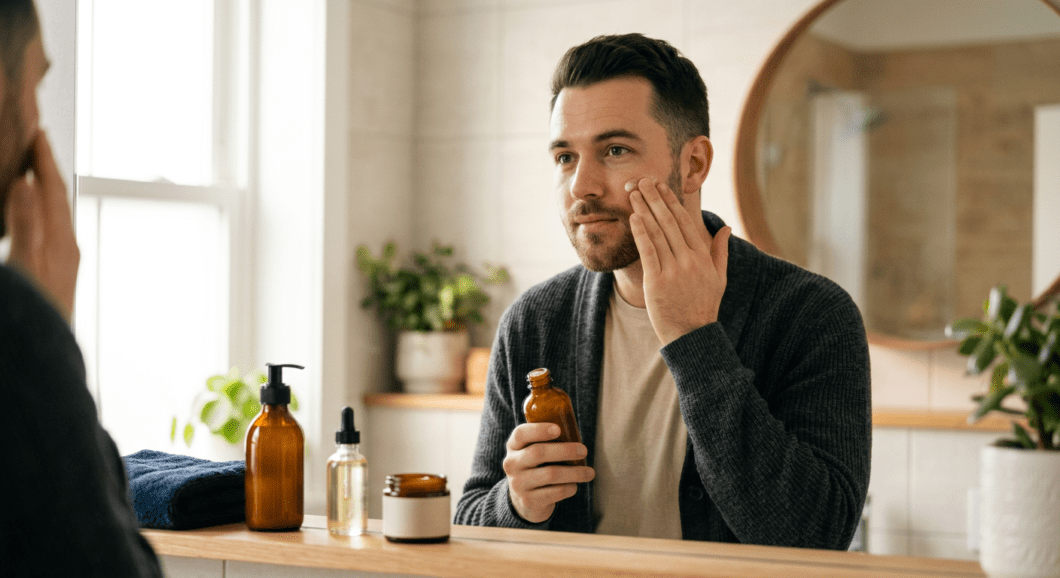

Most men have damaged their skin barrier without knowing it. The culprit isn’t genetics — it’s the aggressive scrubbing, daily shaving, and “the harsher the better” approach that defined male grooming for decades. As the US men’s grooming market approaches $32.74 billion in 2026, the category is shifting away from reactive damage control and toward understanding what skin actually needs to function. The skin barrier is where that conversation starts.
What the Skin Barrier Actually Does

The skin barrier — technically the stratum corneum — is the outermost layer of skin. The standard analogy holds up: skin cells are the bricks, lipids are the mortar. When that structure is intact, moisture stays in and irritants stay out.
When it breaks down, the symptoms are recognizable: persistent redness, tightness after washing, unexpected oiliness, breakouts that don’t respond to your usual products. These aren’t separate problems with separate causes. They’re different expressions of the same underlying issue.
Male skin has a few structural differences worth knowing. It runs roughly 20–25% thicker than female skin and produces more sebum. It’s also subjected to the daily mechanical stress of shaving, which functions as physical exfoliation every single time — a fact that matters when you’re deciding what else to put your skin through.
Why Men Are More Vulnerable to Barrier Damage

The grooming habits that feel most effective are often the most destructive. According to Dermascope, over-exfoliation is one of the most common and least recognized contributors to barrier disruption in men — and shaving is the hidden multiplier.
Shave in the morning, then follow with an exfoliating cleanser, and you’ve exfoliated twice before 8 a.m. Add a gritty scrub three times a week on top of that, and the skin never gets adequate recovery time. This overlap is the pattern professionals see repeatedly in male clients presenting with irritation, congestion, or unpredictable oil production.
Environmental factors compound the problem. Frequent hot showers, alcohol-based aftershaves, and fragrance-heavy products all strip the lipid layer that holds the barrier together. The skin compensates by producing more oil — which many men then try to strip away with more aggressive products. The cycle reinforces itself.
The Science Behind Barrier-Repairing Ingredients

Knowing what to look for on a label is the difference between a routine that heals and one that continues the damage.
Ceramides
Ceramides are lipids that naturally occur in the skin barrier — they make up roughly 50% of its lipid matrix. Topical ceramides replenish what shaving, cleansing, and environmental stress deplete. Look for ceramide NP, AP, or EOP on ingredient lists.
Niacinamide
Niacinamide (vitamin B3) supports ceramide production, reduces inflammation, and strengthens the barrier over time. It’s one of the most well-tolerated actives available, and it works across all skin types, including oily and acne-prone.
Hyaluronic Acid and Glycerin
These humectants draw moisture into the skin and hold it there. They don’t repair the barrier directly, but they maintain the hydration levels the barrier needs to function. As Evan Alexander Grooming notes, consistent use helps retain moisture and supports barrier integrity.
What to Avoid
Building a Barrier-First Grooming Routine

A barrier-focused routine doesn’t require ten steps. It requires the right steps in the right order. GQ’s skincare guide frames it as: cleanse, hydrate, rejuvenate, protect. That framework holds — but the products you choose within it determine whether you’re building or breaking your barrier.
Morning Routine
- Cleanse with a gentle, sulfate-free face wash — not bar soap or body wash
- Apply a niacinamide or ceramide serum while skin is still slightly damp
- Moisturize with a lightweight formula containing ceramides or glycerin
- Apply SPF 30 or higher — UV exposure is a primary driver of barrier degradation
Shaving Protocol
Shave after cleansing, not before. Warm water and a cleanser soften the hair and prep the skin, which reduces blade friction. If you’re prone to irritation, a single-blade or safety razor creates less mechanical stress per pass than a multi-blade cartridge. Follow immediately with a fragrance-free, alcohol-free post-shave balm — look for allantoin or panthenol on the label.
Evening Routine
- Cleanse again if you’ve been in polluted air or wore sunscreen
- Apply a ceramide-rich moisturizer — this is when the skin does most of its repair work
- Add retinol 2–3 nights per week once your barrier is stable, not during an active repair phase
Exfoliate no more than once per week. Skip exfoliation entirely on shave days.
The Grooming Market Is Responding to This Shift

The industry isn’t just talking about barrier care — it’s building products around it. The global men’s grooming market is projected to surpass $100 billion by 2030, with barrier repair emerging as one of the defining product categories of 2026.
Search trend data shows interest in men’s premium skincare at all-time highs in 2026. Gen Z men are driving adoption of multi-step routines and ingredient-conscious purchasing, according to men’s skincare statistics from StriveSkin. These aren’t niche behaviors anymore.
Brands are responding with hybrid products — moisturizers with built-in SPF, serums combining niacinamide with hyaluronic acid, post-shave treatments formulated with ceramides instead of alcohol. The single-product-does-everything approach is giving way to targeted, layered care that actually addresses the barrier.
Common Mistakes That Undermine Barrier Health

Men who have adopted a skincare routine often make a few consistent errors that prevent real progress.
Using too many actives at once. Retinol, AHAs, vitamin C, and benzoyl peroxide are all effective, but layering them without recovery time creates cumulative irritation. Introduce one new active at a time, spaced at least two weeks apart.
Skipping SPF. UV radiation breaks down collagen and directly damages the lipid matrix. Daily SPF isn’t optional if barrier health is the goal. As One Society’s science-backed grooming guide notes, grooming is now understood as a commitment to skin barrier function, not just appearance.
Washing with hot water. Hot water dissolves the lipid layer more aggressively than lukewarm water. It feels thorough, but it’s destructive to the barrier. Lukewarm water for both cleansing and rinsing.
Treating oily skin with more stripping. Oiliness is often a barrier response — the skin overproduces sebum when the barrier is compromised. Stripping it further worsens the problem. The fix is hydration and barrier repair, not more aggressive cleansing.
Conclusion
A functioning skin barrier is what makes every other part of your grooming routine work. Without it, moisturizer can’t hydrate effectively, actives cause irritation instead of results, and the skin stays in a constant state of reactive damage.
What’s shifting in men’s grooming right now isn’t just spending — it’s understanding. Gentle cleansing, consistent moisturizing, daily SPF, and a restrained approach to exfoliation represent a meaningful departure from how most men were taught to treat their skin.
Audit your current routine against the damage list above. Swap one harsh product for a barrier-friendly alternative this week. Most men see visible improvement within two to four weeks, and the habits compound from there.
Frequently Asked Questions
Q: How do I know if my skin barrier is damaged?
Persistent redness, tightness after washing, breakouts despite a consistent routine, and sudden sensitivity to products you’ve used before are all reliable signs. Flakiness alongside oiliness — not one or the other, but both — is another strong indicator.
Q: How long does it take to repair a damaged skin barrier?
Most men see meaningful improvement within two to four weeks of switching to a barrier-supportive routine. Full restoration of the lipid matrix can take up to eight weeks, depending on the degree of damage and how consistently the new routine is followed.
Q: Can men with oily skin still use a moisturizer?
They should. Oily skin is often a sign of barrier disruption, where the skin overproduces sebum to compensate for lost moisture. A lightweight, oil-free moisturizer with glycerin or niacinamide addresses the root cause without adding heaviness.
Q: Is shaving every day bad for the skin barrier?
Daily shaving does create cumulative mechanical stress. You can reduce the damage by shaving after cleansing, using a sharp single-blade razor, and applying a fragrance-free post-shave balm immediately after. Skip any additional exfoliation on shave days.
Q: What’s the single most important product for barrier repair?
A ceramide-containing moisturizer. Ceramides directly replenish the lipid matrix that holds the barrier together, making them more targeted for this purpose than general hydrators alone.
Q: Do men need different skincare products than women?
Male skin is thicker and produces more sebum, which can influence texture preferences — lighter formulas tend to feel better. The core barrier-repairing ingredients (ceramides, niacinamide, hyaluronic acid) work the same way regardless of sex. Most product differences are marketing rather than biology.