

Ever walked into a fragrance store feeling a bit overwhelmed by all the options? AI mood scenting is changing that by using perfumery smarts and AI to match scents to your current mood. You’ll see how it analyzes your emotions for spot-on recommendations, making shopping for fragrance more personal than ever.
Key Takeaways:
What is AI Mood Scenting?
AI mood scenting blends Artificial Intelligence with perfumery to create fragrances tailored to your emotional state, transforming how scents influence daily well-being and mental health. This innovation in the industry uses AI to analyze personal mood data and recommend scent profiles that enhance concentration, happiness, or relaxation.
For example, Osmo‘s Osmo’s Generation technology generates custom mood-boosting perfumes by interpreting user inputs like stress levels or energy. Companies like dsm-firmenich and Givaudan apply similar approaches to match synthetic molecules with emotional needs, making personalization accessible through apps.
Perfumers once relied on intuition, but now AI tools like Philyra by Symrise predict scent outcomes from molecular data. This shift supports sustainable perfumery by optimizing formulas, reducing waste in production. Users benefit from scents that align with mental health goals, such as calming lavender notes during high anxiety.
Brands like EveryHuman and Scentmate digitise smell to offer virtual try-ons, bridging traditional perfumery with digital olfaction. Osmo and Myrissi lead in creating AI-driven fragrances that adapt to daily moods, revolutionizing shopping experiences worldwide.
Core Technology Explained
At its heart, AI mood scenting relies on machine learning algorithms trained on vast fragrance molecule databases to generate mood-aligned scent compositions. Neural networks analyze molecular structures to predict how scents interact with human emotions, drawing from perfumery archives.
Osmo’s Generation technology, for instance, uses generative AI to compose novel fragrance formulas from inputs like desired mood effects. Symrise‘s Philyra employs similar neural networks to explore millions of scent variations, ensuring IFRA compliance while innovating with white biotechnology.
These systems map molecules to sensory outcomes, as shown in a simple diagram placeholder below for molecule-to-mood mapping. Experts in digital olfaction, like those at Firmenich, note how this tech speeds up development of sustainable fragrances.
Diagram Placeholder: Molecule-to-Mood Mapping
Practical applications include tools like Scent Visualizer and ScentGenie, which help perfumers visualize AI suggestions. This core technology drives market growth in regions like China and the Far East, where Puig and Wikiparfums digitise personalization.
Mood Detection Mechanisms
AI systems detect mood through sensors capturing facial expressions, voice tone, and physiological signals, drawing from neuroscience principles. Facial micro-expression analysis identifies subtle cues of stress or joy, while heart rate variability reveals arousal levels.
Neuroscientists understand scent-mood links through olfactory pathways that directly influence emotions, bypassing conscious thought. Tools like Focus by Emoticode and MoodScentz+ integrate these mechanisms into fragrance apps for real-time mood assessment.
For example, a wearable might track voice pitch during a call to suggest uplifting citrus scents for low energy. Heart rate variability data pairs with scent databases to recommend calming profiles, enhancing concentration or happiness.
Brands such as FairScent and Kaorium combine these signals with AI for precise personalization. This approach, rooted in general neuroscientific insights, transforms shopping by aligning fragrances with emotional states post-pandemic.
The Evolution of Fragrance Shopping
Fragrance shopping has shifted from in-store spritzes to digital experiences, accelerated by the pandemic and demands for personalization.
Traditional retail meant testing scents on skin in crowded stores. Shoppers faced scent uncertainty as fragrances changed over time and on different bodies. This limited confident purchases.
Digital tools emerged to solve these issues. Virtual try-ons like Wikiparfums and Myrissi let users preview perfumes online. AI now predicts how scents interact with personal chemistry.
Companies such as Puig drive this change with innovative platforms. The fragrance industry uses technology to match moods and preferences precisely. This evolution makes shopping more accessible worldwide.
Timeline of Key Milestones
| Era | Milestone | Impact |
|---|---|---|
| Pre-2020 | Traditional retail dominance | Relied on physical stores for scent testing, leading to high return rates from uncertainty. |
| 2020 Pandemic | Shift to virtual try-ons | Platforms like Wikiparfums offered digital previews, reducing in-person risks. |
| 2021-2022 | AI personalization tools | Myrissi used algorithms to simulate scent on skin, addressing body chemistry variations. |
| 2023-Present | AI mood scenting | Innovations from Osmo and EveryHuman predict emotional responses, boosting customer satisfaction. |
This timeline shows steady progress toward digital olfaction. Early tools digitized visuals of bottles. Now, AI analyzes molecules for true scent simulation.
Brands like dsm-firmenich and Firmenich integrate tools such as Scentmate for custom blends. Shoppers gain confidence without wasting product. The path leads to full AI-driven personalization.
How AI Analyzes Your Mood
AI processes real-time data from your expressions and biometrics to understand emotional states and match them with ideal scents. This step-by-step process starts with capturing inputs like facial cues and heart rate. It then analyzes patterns to detect moods such as stress or joy.
Next, machine learning algorithms compare this data against vast databases of fragrance profiles. Companies like Givaudan and Firmenich contribute scent libraries linked to emotional responses. The system outputs personalized recommendations, such as lavender for calm.
Privacy remains central throughout. Users must give explicit consent for data collection, and secure encryption protects biometric information. Experts recommend checking app policies to ensure compliance with standards like IFRA.
Imagine feeling stressed after a long day. The AI detects furrowed brows and elevated heart rate, then suggests a calming lavender note from MoodScentz+ or Symrise blends. This makes shopping for perfumes intuitive and mood-boosting.
Facial Recognition and Biometrics
Facial recognition software identifies subtle emotional cues while biometric sensors track heart rate and skin conductance for deeper mood insights. Tools like IBM‘s emotion AI scan micro-expressions for joy or tension. Wearables from Osmo integrate seamlessly with apps like EveryHuman.
Common biometric signals guide scent matches. For example, high heart rate from stress pairs with lavender or chamomile notes. Elevated skin conductance during excitement suggests citrus for energy.
- Heart rate: Fast beats signal anxiety, recommending sandalwood for grounding.
- Skin conductance: Sweat responses indicate arousal, pairing with peppermint for focus.
- Facial cues: Smiles trigger happiness-boosting rose from Philyra by dsm-firmenich.
Consent and data security are essential best practices. Always verify opt-in features before use, and choose platforms with end-to-end encryption. Innovations from Myrissi and Scentmate prioritize user control in this personalization trend.
Personalized Scent Recommendations
AI curates bespoke fragrance profiles by combining your mood data with preferences, eliminating guesswork in scent selection. This personalization process draws from advancements in digital olfaction and perfumery technology. Platforms like EveryHuman and Scentmate lead this innovation in the fragrance industry.
The recommendation process follows clear steps to match scents with your unique profile. Users input data on daily moods, past favorites, and even skin type. AI then analyzes these elements against vast libraries of fragrance molecules.
- Enter your mood data, such as feeling energized or relaxed, via app prompts.
- Share preferences, like loving citrus notes or woody bases from previous perfumes.
- Artificial Intelligence processes this with sustainable synthetic molecules databases from firms like Firmenich, Givaudan, and dsm-firmenich.
- Receive tailored suggestions, complete with virtual scent previews using tools like Scent Visualizer.
Consider Sarah, a Noteworthy user, who struggled to find her signature scent amid endless sampling. Using Scentmate, she logged post-workout happiness moods and a preference for fresh aquatics. The AI recommended a custom blend echoing Osmo’s Generation tech, becoming her daily go-to.
Scentmate excels in real-time mood tracking tied to neuroscientists‘ insights on scent and mental health. EveryHuman focuses on community-driven profiles, blending user reviews with AI for broader appeal. Both outpace traditional shopping by digitizing smell effectively.
Key Players and Innovations
Industry leaders like dsm-firmenich, Givaudan, and startups such as Osmo drive AI innovation in perfumery. These companies blend artificial intelligence with traditional scent creation to push boundaries in fragrance development. Their efforts focus on personalization and efficiency for modern consumers.
Symrise’s Philyra stands out as a pioneering AI system trained on vast libraries of fragrance molecules. It assists perfumers by suggesting novel combinations that mimic expert blends. This technology speeds up the creative process while maintaining artistic control.
Osmo‘s Generation uses digital olfaction to map scents mathematically, enabling computers to generate new fragrance formulas. Startups like Scentmate offer tools for quick scent matching based on user preferences. Aryballe‘s digital nose detects and analyzes odors with sensor arrays, digitizing smell for precise replication.
Other innovators include EveryHuman with its personalization platforms, Myrissi for virtual scent trials, and NobleAI. These advancements ensure IFRA compliance and explore sustainable synthetic molecules. Together, they transform how the industry creates mood-boosting fragrances.
| Company/Tool | Key Innovation | Focus Area |
|---|---|---|
| Philyra by Symrise | AI-trained on molecule libraries | Formula suggestion and perfumer assistance |
| Osmo’s Generation | Mathematical scent mapping | New fragrance generation |
| Scentmate | AI scent matching | User preference alignment |
| Aryballe | Digital nose sensors | Odor detection and digitization |
| Myrissi | Virtual scent trials | Personalized virtual testing |
Benefits for Consumers
Consumers enjoy scents that genuinely enhance mood and well-being through intelligent matching. AI mood scenting pairs fragrances with personal emotions, like selecting citrus notes for focus during workdays or lavender blends for evening relaxation.
This technology draws on insights from neuroscientists to link scent molecules with mental health responses. Shoppers discover mood-boosting perfumes that support concentration or happiness without trial-and-error guesswork.
Practical value shines in daily life. A parent might choose a sustainable fragrance from dsm-firmenich that calms after a hectic morning, while remote workers opt for Firmenich innovations to sustain energy.
Emotional benefits extend to personalization. Tools like EveryHuman or Scentmate ensure scents align with individual needs, making perfumery more accessible and relevant in a fast-paced world.
Enhanced Shopping Experience
AI transforms fragrance shopping into an intuitive, try-before-you-buy virtual journey. Platforms like Focus by Emoticode and MoodScentz+ use digital olfaction to simulate scents at home.
The process starts simple. Users answer a quick quiz on mood preferences, then AI recommends options like Osmo‘s Generation or Philyra by Givaudan based on synthetic molecules and white biotechnology.
- Select your current mood or desired state, such as energized for meetings.
- Receive virtual samples via apps like Wikiparfums or Myrissi, sniffing through device-enabled scent visualizers.
- Refine choices with feedback, ensuring IFRA compliance and personalization before purchase.
- Order with confidence, as technology digitises smell for remote shoppers worldwide.
This convenience benefits those in the Far East or China, where market growth meets Puig and Symrise innovations. No more store visits during the pandemic era, just seamless access to FairScent or Kaorium tech.
Impact on Retail and Brands
Brands leverage AI mood scenting to boost engagement and sales, particularly in growing markets like China. Retailers deploy in-store kiosks that analyze customer mood via facial recognition and release personalized fragrance samples. This creates immersive shopping experiences that draw shoppers deeper into the fragrance selection process.
In e-commerce integrations, platforms like Wikiparfums and Myrissi use AI to recommend scents based on user-input moods or digital scent profiles. Customers upload preferences, and algorithms suggest matches from brands like Puig or Byredo. This personalization drives higher conversion rates by matching fragrances to emotional needs.
Companies such as Puig explore AI-driven tools like Osmo and EveryHuman for virtual try-ons, allowing global reach without physical samples. Byredo benefits from predictive analytics that forecast trend shifts in mood-boosting scents, refining collections faster. These innovations help brands stand out in competitive markets like the Far East.
Supply chain efficiencies emerge from predictive formulation using AI like Philyra from Givaudan or Scentmate from dsm-firmenich. These systems optimize molecule blends for sustainability, reducing waste in production. Brands achieve IFRA compliance while scaling personalized perfumes efficiently.
Challenges and Limitations
Despite promise, AI scenting faces hurdles in accuracy, regulation, and cultural scent preferences. Systems like Osmo’s Generation and Philyra by Givaudan predict fragrance molecules, but real-world testing often reveals gaps. These issues slow adoption in the perfumery industry.
IFRA compliance adds strict rules on safe ingredient levels in perfumes. AI models must align with these standards to avoid health risks. Companies like dsm-firmenich work to integrate regulations into algorithms for reliable outputs.
Cultural differences shape scent preferences, with Far East markets favoring lighter florals while others prefer bold woods. AI trained on Western data may miss nuances in China or beyond. Hybrid approaches help bridge these divides.
Tech access limits users without advanced tools, creating barriers for small perfumers. Practical solutions include hybrid human-AI validation, where experts refine AI suggestions. Tools like Scentmate from Symrise combine tech with perfumer input for balanced results.
The Future of Mood-Based Fragrance Shopping
Advancements in digital olfaction promise scent delivery through devices and fully virtual olfactory experiences. Technologies like ScentGenie and research from the Institute of Science Tokyo are pioneering ways to recreate smells digitally. This shift allows shoppers to sample fragrances remotely before buying.
Emerging tools such as Osmo and EveryHuman enable precise mapping of scent molecules for virtual trials. Consumers can match perfumes to their mood using AI-driven apps. Experts predict this will transform perfumery into a more interactive process.
Sustainable AI formulation trends point to tools like Scentmate from dsm-firmenich and white biotechnology for eco-friendly synthetic molecules. Companies including Givaudan and Symrise use AI to design mood-boosting fragrances with fewer resources. Global personalization will expand, especially in markets like China and the Far East.
Picture a future where AI curates scents for mental health and concentration, delivered via devices from Kaorium or FairScent. Shoppers enjoy tailored experiences compliant with IFRA compliance standards through innovations like Philyra. This vision puts personalized, sustainable fragrances at every consumer’s fingertips.
Frequently Asked Questions
What is AI Mood Scenting and How AI Mood Scenting Is Changing the Way We Shop for Fragrance?
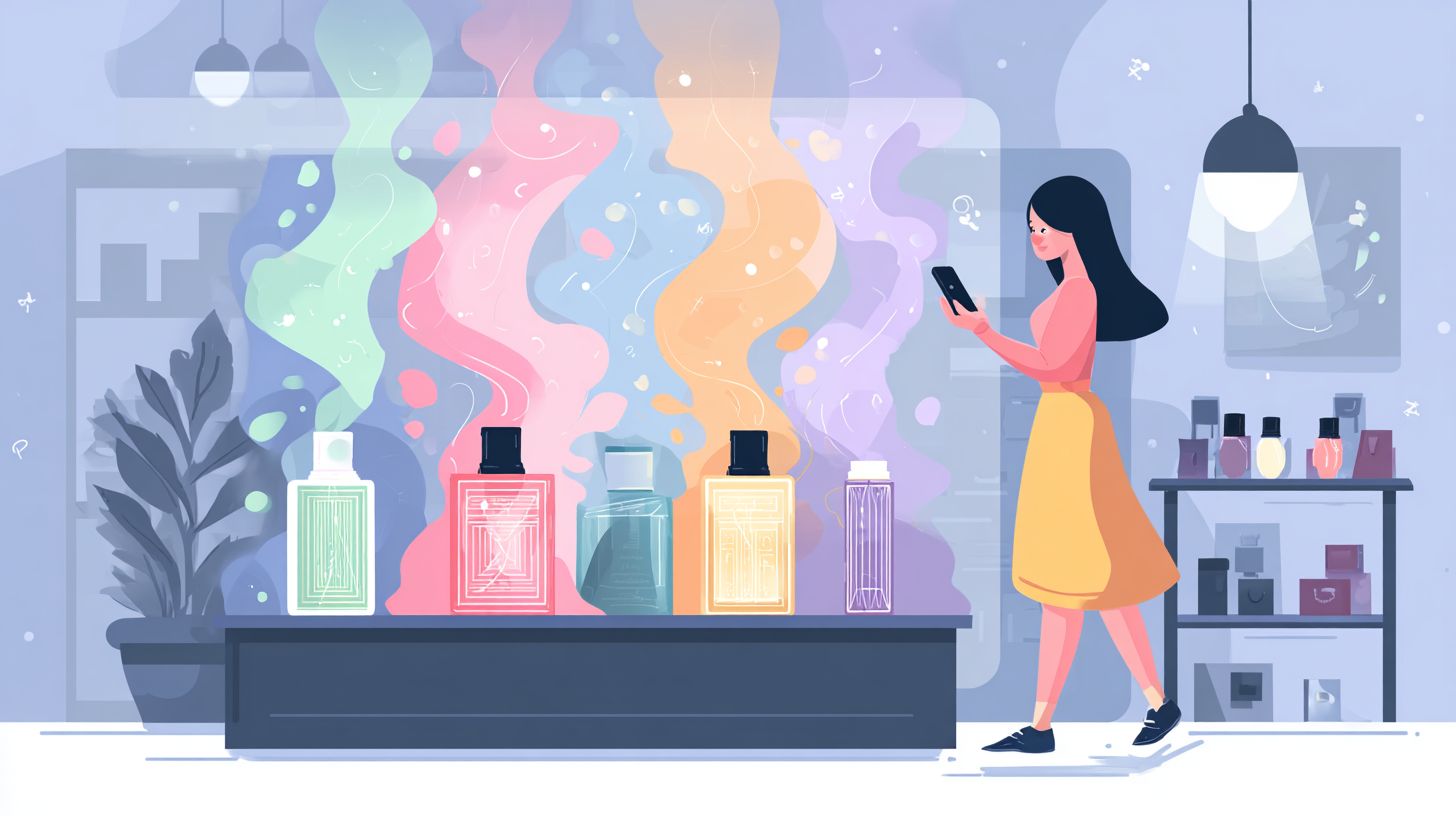
AI Mood Scenting is an innovative technology that uses Artificial Intelligence to analyze a user’s current mood-through facial recognition, voice tone, or biometric data-and recommends personalized fragrances that match or enhance that emotional state, including options like NINU Perfume and OnScent. How AI Mood Scenting Is Changing the Way We Shop for Fragrance lies in transforming traditional shopping into a dynamic, emotion-driven experience, where scents are suggested in real-time via apps or in-store kiosks, making fragrance selection more intuitive and satisfying.
How does AI Mood Scenting personalize fragrance recommendations with tools like Scent Visualizer and ScentGenie?
By integrating data from wearables, cameras, or questionnaires, AI (Artificial Intelligence) Mood Scenting identifies emotions like stress or joy and pairs them with scent profiles-such as calming lavender for anxiety or energizing citrus for motivation. This personalization is revolutionizing How AI Mood Scenting Is Changing the Way We Shop for Fragrance, moving away from generic trials to bespoke matches that boost customer loyalty.
What are the benefits of using AI Mood Scenting in fragrance retail?
Key benefits include higher conversion rates, reduced returns due to better matches, and enhanced customer engagement through interactive experiences. How AI Mood Scenting Is Changing the Way We Shop for Fragrance is evident in shorter decision times and increased sales, as shoppers discover scents aligned with their mood rather than browsing endlessly.
Which brands are leading in AI Mood Scenting technology?
Brands like Sephora with its Virtual Artist app, and innovators such as Firmenich, Givaudan, Symrise, Puig, and EveryHuman, are pioneering AI Mood Scenting integrations. This leadership is a core part of How AI Mood Scenting Is Changing the Way We Shop for Fragrance, setting new standards with AR try-ons and mood-based virtual consultations.
Is AI Mood Scenting accessible for online fragrance shopping?
Yes, many e-commerce platforms like Wikiparfums and Myrissi now offer AI Mood Scenting via webcam analysis or mood quizzes during checkout. This online adaptation is central to How AI Mood Scenting Is Changing the Way We Shop for Fragrance, bridging the gap between physical sampling and digital purchases with predictive scent simulations.
What does the future hold for AI Mood Scenting in fragrance shopping?
The future includes deeper integrations with smart homes and VR technologies like Osmo, Osmo’s Generation, Focus by Emoticode, MoodScentz+, Scentmate, FairScent, Kaorium, Scent Visualizer, ScentGenie, Philyra, IFF, Aryballe, NobleAI, Moodify, Byredo, Noteworthy, NINU Perfume, OnScent, where ambient moods trigger auto-reorders. How AI Mood Scenting Is Changing the Way We Shop for Fragrance will evolve into seamless, predictive ecosystems adhering to IFRA compliance, making fragrance a proactive part of daily emotional wellness from innovators in China, Far East, and the Institute of Science Tokyo to global players like IBM.